Master-Data Templates
Purpose
Master-Data Templates help Professional Services predefine billing types, SLAs, and contingents directly on resources, customers, or items. This means recurring contract models are not built from scratch in each document, but transferred consistently from the underlying master data.
Prerequisites
- templates for billing types, SLAs, and contingents are defined from a business perspective
- the relevant master data such as resources, customers, or items is maintained
- it is clear which templates should be transferred automatically during document creation
Functional focus
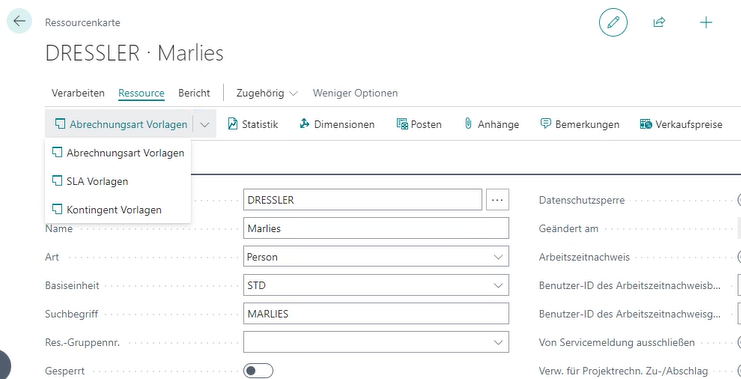
Templates on resources
Resources can store templates for billing types, SLAs, and contingents. When a contract-related document is later created for that resource, the required contract elements are already prepared.
Templates on customers
Customers can also carry the relevant templates. This ensures that recurring service and contract logic can be transferred directly from the customer context into sales contracts or similar documents.
Templates on items
Items can use the same template concept to standardize contract-related services early. When the item is used in a suitable document, the corresponding templates are transferred into the contract or billing logic.
Benefit during document creation
Master-data templates reduce manual maintenance effort and help build similar contract models consistently across multiple customer or service cases. They therefore act as a central bridge between master-data maintenance and contract-related document creation.
Outcome
Master-Data Templates shift recurring contract logic into the master-data foundation. This prepares billing types, SLAs, and contingents consistently and transfers them into document creation in a repeatable way.
Links