Glossary
Purpose
This glossary consolidates the key terms and roles used in Handling Unit Management. It helps teams apply the same business language across master data, packaging structures, and operational packaging assignments.
Business value
- Standardizes terminology for packaging means, packaging materials, contents, and hierarchy levels.
- Makes collaboration easier across master data maintenance, order processing, and warehouse operations.
- Reduces misunderstandings around alternatives, weights, and document assignments.
Content focus
Core terms
| Term | Description | Typical context |
|---|---|---|
| Packaged goods | Generic business term for the goods that are packed, moved, or contained in a structure. | Item, content of a packaging unit |
| Content | Concrete item to be packed or already packed within a packaging structure or packaging assignment. | Content line, item in the structure |
| Package | Movable real-world combination of packaging means and packaged goods. | Shipping unit, finished package |
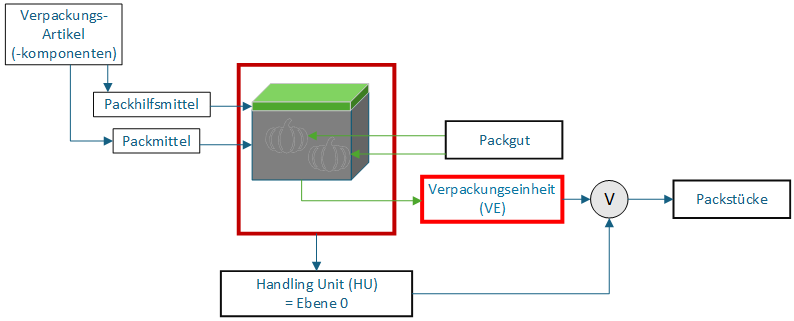
| Packaging means (Packmittel) | Structural packaging component that contains, groups, or organizes contents or other packaging components. | Pallet, box, KLT, insert |
| Packaging material (Verpackungsmaterial) | Physical empty unit of a packaging means with its own quantity, availability, and often its own weight. | Packaging-material line, warehouse-managed material |
| Packaging aid | Supporting packaging component used together with packaging means. | Accessory, separator, auxiliary material |
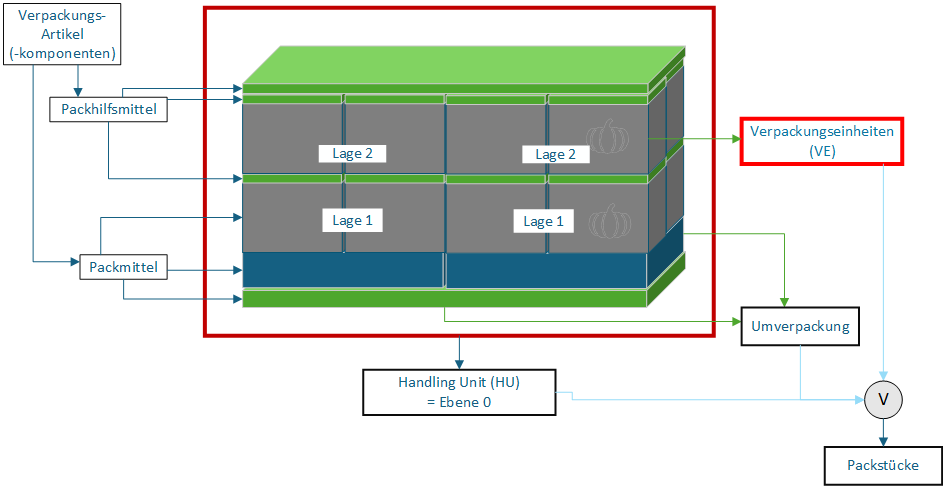
| Outer packaging | Higher packaging level that contains multiple units. | Carton, layer, secondary packaging |
| Packaging unit | Smallest defined pack unit with a fixed quantity. | Single, packaging unit |
| Handling unit | Highest movable unit within the structure. | Master, load carrier |
| Packaging structure | Hierarchical model of packaging means, aids, and contents as a reusable template or real structure. | Structure definition, real packaging |
| Assignment | Concrete link between a structure, hierarchy level, or line and a master-data or document context. | Assignment field, hierarchy, document context |
| Document packaging structure | Document-specific variant of a packaging structure that is proposed, selected, or maintained as an alternative for a specific context. | Sales, purchase, transfer |
| Packaging assignment | Operational use, adjustment, and registration of the real structure on the concrete document. | Shipping, warehouse shipment, posting |
| Alternative | Variant of a packaging structure for the same business context. | Customer-specific or regional packaging |
| Net/gross weight | Weight of the content without and with packaging; these values drive shipping and validation checks. | Calculation, shipping, registration |
| Overload | Situation in which the gross weight or another defined limit is exceeded. | Validation rule, weight limit |
| Structure level role | Optional industry-neutral role on a packaging-structure definition line: Logistic Unit, Item Package, or Accessory. |
Packaging-structure definition, EDI or label output |
| Package-type default role | Default value on the package type that can be inherited when the structure level role is still blank. | Packaging-structure maintenance |
| Structural derivation | Automatic fallback derivation of the output role from the packaging tree when no role is maintained or no definition is linked. | Goods label, label output |
| Loading Unit Print Buffer | CSC buffer populated by the HUM-CSC connector with posted HUM packages for transport and report output. | CMR, VDA4922 |
Example structure levels
The following illustration shows the basic relationship between packaging aids, packaging materials, packaging units, and the handling unit.
For multi-level scenarios, the same logic can be extended to layers and outer packaging.
Roles and typical flow
| Role | Typical task |
|---|---|
| Master data | Maintain packaging means, packaging materials, weights, and attributes |
| Planning or engineering | Define standard packaging structures as reusable templates |
| Business owner | Review and release structures |
| Order processing | Select the appropriate structure or alternative on the document |
| Warehouse and shipping | Adjust, register, and post the packaging assignment |
| Goods receipt | Track incoming structures and tracking data |
Difference between structure and assignment
A packaging structure describes the reusable business template. The assignment links that structure or individual hierarchy levels to a concrete master-data or document context. The document packaging structure is the resulting document-specific structure variant. The packaging assignment is the operational use and processing of that structure in the running document process. This separation keeps the master-data logic reusable while allowing operational deviations to be processed directly in the document.
Result
- Teams use the same terminology for structure design, assignment, and posting.
- Roles along the lifecycle of a handling unit are clearly distinguished.
- The other HUM pages can be read and maintained using one shared vocabulary.
Links