General Ledger Accounting
The chart of accounts forms the basis for general ledger accounting. In the chart of accounts, movements from all business transactions are arranged by subject. Based on the chart of accounts framework, the basic evaluations, such as the balance sheet and profit and loss statement, are defined and provided in account schedules.
Chart of accounts
The chart of accounts is set up in consultation with the customer. The structuring of general ledger accounts can be chosen freely. The general ledger account numbers can be alphanumeric with a maximum of 20 characters. An account type can be used to further structure or group the chart of accounts in order to define account areas more quickly for evaluations. Through master data management, consistency of the chart of accounts can be established across defined companies if several companies have the same chart of accounts.
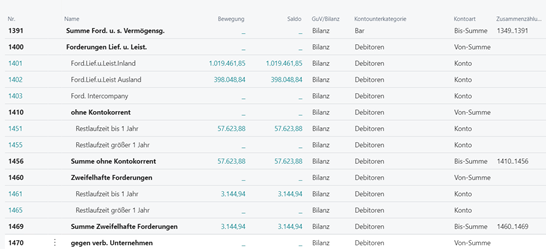
Further information on the general ledger account includes:
- Account type (heading, account total)
- Tax posting groups (for manual postings)
- P&L/balance sheet indicator
- Open-item-managed general ledger account
- Block indicator
- Direct posting (distinction between automatic general ledger account and directly postable general ledger account)
Posting groups
So-called posting groups are used to control the integration of subledgers (customers, vendors, banks, fixed assets, items) into the general ledger.
Posting matrix
In the merchandise management posting matrix, the accounts are defined that are to be addressed automatically and that are relevant for financial accounting (for example purchase/sales invoices) when posting processes are posted in merchandise management. Control is handled by posting groups that depend on the business partner (customer/vendor) on the one hand and on the product (item, fixed asset, resource) on the other hand. In combination, the corresponding account is determined. The purchasing, sales, and warehouse modules are integrated here.
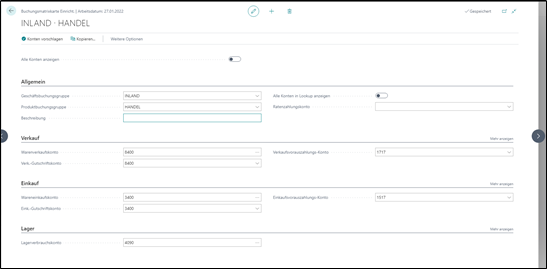
VAT posting matrix
In addition to the merchandise management posting matrix, the VAT posting matrix is also set up. As with the merchandise management posting matrix, tax calculation and the determination of tax accounts are carried out via the business partner and the product in an underlying business transaction. VAT settlement is based on the VAT settlement summarized in Microsoft Dynamics 365 Business Central.
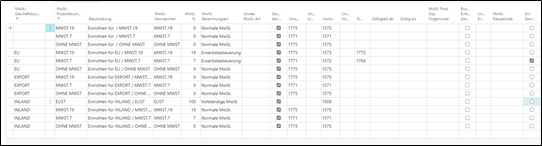
Finance dimensions
The finance dimensions are defined by financial accounting (controlling) and are included automatically or manually during postings. These dimensions are additional attributes of a general ledger posting and can be integrated in various reporting evaluations. In addition to two main dimensions (which can be evaluated directly), six further dimensions can be created and posted. The dimensions can be selected by the user for each posting transaction or automatically defaulted through the selection of other data. The following global dimensions are available by default. These can be extended by any dimensions. A maximum of 8 dimensions can be used.
- Global dimension 1: Cost center
- Global dimension 2: Cost object
- Further dimensions
Manual financial postings in the general ledger
Manual postings are recorded in so-called journals. There are different journals (sales journals, payment receipt journals, general journals, etc.). These are optimized for the respective business transactions. In addition to journals, so-called recurring journals are available. They are used to manage postings that must be carried out continuously according to their type and/or amount. These include, among others, monthly rents, insurance, or personnel costs. The journals are prepared by BE-terna GmbH according to a best-practice setup. Further maintenance is then carried out by the customer. These entries are transferred to financial accounting as general ledger postings only after posting.
Print reports for general ledger accounting
The following reports must be set up and, if necessary, adapted as part of the project